Steffany DeVoursney

AboutillustrationDesign

Fly 'n' shine

The project

Crystal Clean Auto Detailing offers a premium airport car detailing service called Fly 'n' Shine, customers drop their car at the airport, fly out, and return to a freshly detailed vehicle waiting for them. The idea was great, but the operation behind it was held together manually. Bookings came through a generic multi-service contact form. Payment was collected over the phone. The front desk manager tracked appointments in Podio and had to manually send status update emails to clients when he remembered. Customers were frequently calling or emailing to ask where their car was. The goal of this project was to design and build an end-to-end digital system that could handle the full Fly 'n' Shine workflow from customer booking to car return without requiring manual intervention at any step.

The research

The starting point was understanding exactly where the existing process broke down. I spoke with the owners, manager of the Fly ’n’ Shine program, car detailers, as well as a prior client to map the full operational workflow from the moment a customer submitted a request to the moment their car was returned.

The original process had seven manual steps that could each introduce error or delay. For example, receiving the form submission, calling the customer to collect flight dates and vehicle details, collecting payment over the phone, manually entering the appointment into Podio, contacting the detailers to get status updates, writing and sending individual customer emails at each status change, and following up with customers who called asking where their car was.

The customer experience reflected all of this. Because there was no structured booking flow, customers submitted incomplete information and had to be called back. Because payment happened over the phone, there was no clear confirmation moment customers weren't sure if they actually had an appointment unless Crystal Clean sent a follow up email. Because status emails were sent manually and inconsistently, customers defaulted to calling the office to check on their car, which added to managers’ workload and created anxiety for customers who'd left their vehicle with someone they'd only interacted with once over a phone call.

A secondary problem emerged in the data: a meaningful number of people were starting the booking process and not completing payment, potential revenue that was disappearing with no visibility or follow-up mechanism.

Key research findings

  • The manual call-back to collect details was the biggest friction point for both staff and customers, a structured form could eliminate it entirely

  • Payment over the phone was a trust and confirmation gap, integrating Stripe into the booking flow would create a clear commitment moment

  • Customers needed proactive status communication, not reactive, the pattern of customers calling to ask questions indicated an anxiety gap that automated emails could close

  • Incomplete bookings represented lost revenue with no existing recovery mechanism

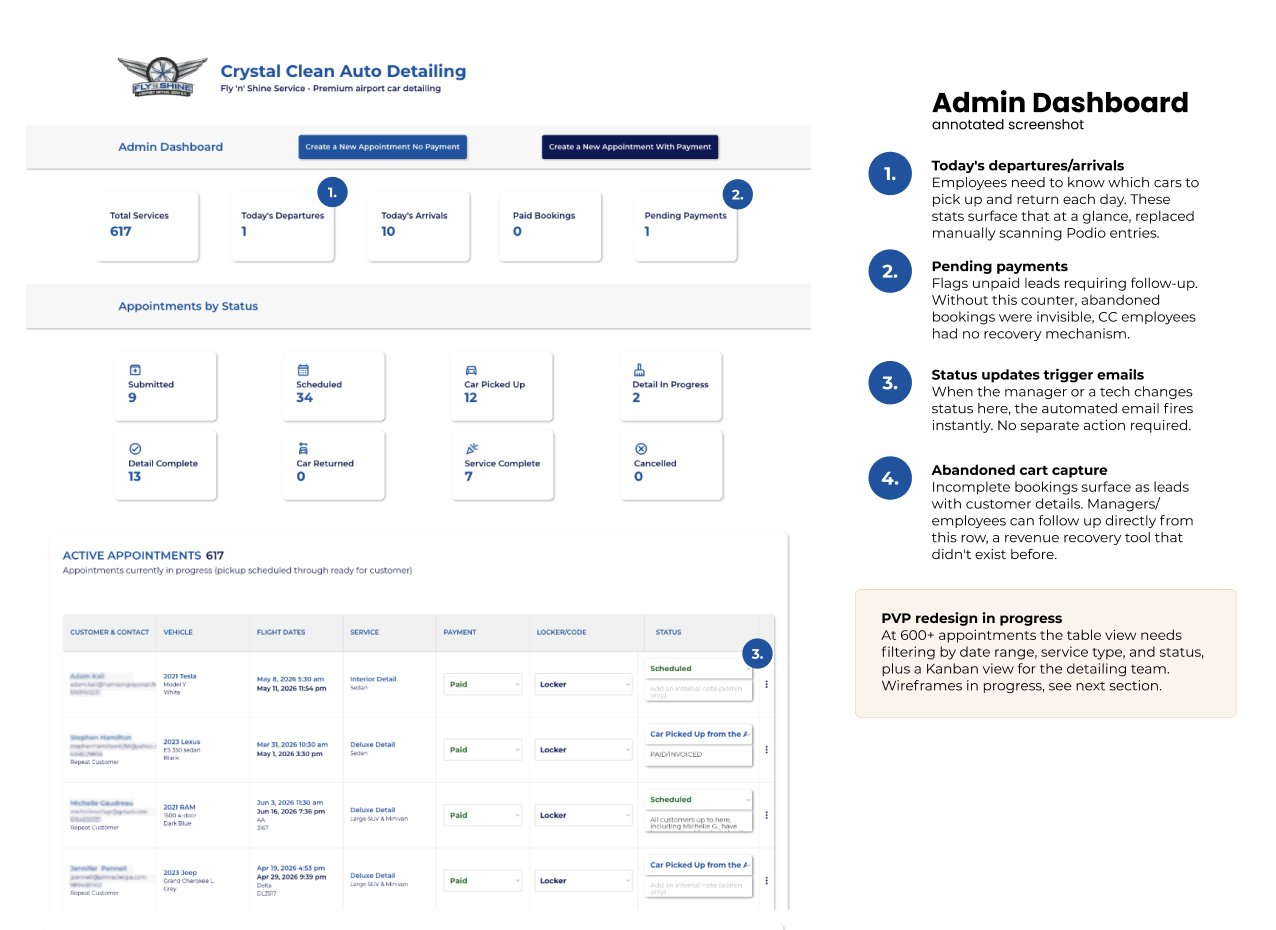
  • Manager and detailers needed a single operations view that showed them departures, arrivals, and appointment status without switching between systems

The research

THE STRATEGY

Rather than patching the existing form, I rebuilt the entire customer-facing and operational workflow as a purpose-built system in Bubble.io.

The booking form was redesigned as a structured 7-step intake that collected everything needed to run the appointment in one session: customer contact info, departure flight details, return flight details, vehicle information, service selection with dynamic pricing, referral source, and payment. Integrating Stripe directly into the final step meant payment was collected at booking, creating a clear confirmation moment and eliminating the phone payment step entirely.

A lead capture system was added at the payment step: if a customer completed the form but didn't finalize payment, a pending lead ticket was automatically created in the admin dashboard, giving the manager a targeted list to follow up with rather than losing those customers entirely.
The admin dashboard was built to replace Podio as the operational hub, organizing all appointments into four live views, Active, Submitted, Completed, and Unpaid Leads with flight dates, service details, payment status, and locker assignments visible in one place. The manager and the detailing technicians can update appointment status directly from the dashboard, triggering the next step in the automated email sequence without any manual action.

The automated email system was designed around the customer's anxiety, not just the operational steps. At every status change submitted, scheduled, car picked up, detailing in progress, detailing complete, car returned to airport, the customer receives an email with a Domino's-style progress tracker showing exactly where their car is, a summary of their booking details, and contextually relevant actions (tracking link when the car is in progress, locker pickup instructions and Google review request when the car is returned). No email requires an employee to write or send anything.

A public-facing tracking page gives customers a real-time view of their car's status and full appointment history, accessible via a unique link included in every email directly addressing the pattern of customers calling to ask for updates.

THE RESULTS

The system eliminated manual steps across the entire Fly 'n' Shine workflow. Kyle no longer calls customers to collect details, processes payments over the phone, manually enters appointments into a separate system, or writes individual status emails. The detailing team updates appointment status directly, and customers receive immediate confirmation at every stage. Integrating this dashboard with Google Calendar offers an at a glance schedule.

The business impact was measurable. February 2026 the first high volume month on the new system generated the best February revenue in the company's history, nearly doubling the previous February record of $36,000. The month finished with 138 total services and revenue tracking toward their highest month ever, with the team noting they had to cut off dates around spring break because they were at capacity.

The abandoned cart lead system surfaced a recovery opportunity that hadn't previously existed, giving the manager a direct follow-up list for incomplete bookings.

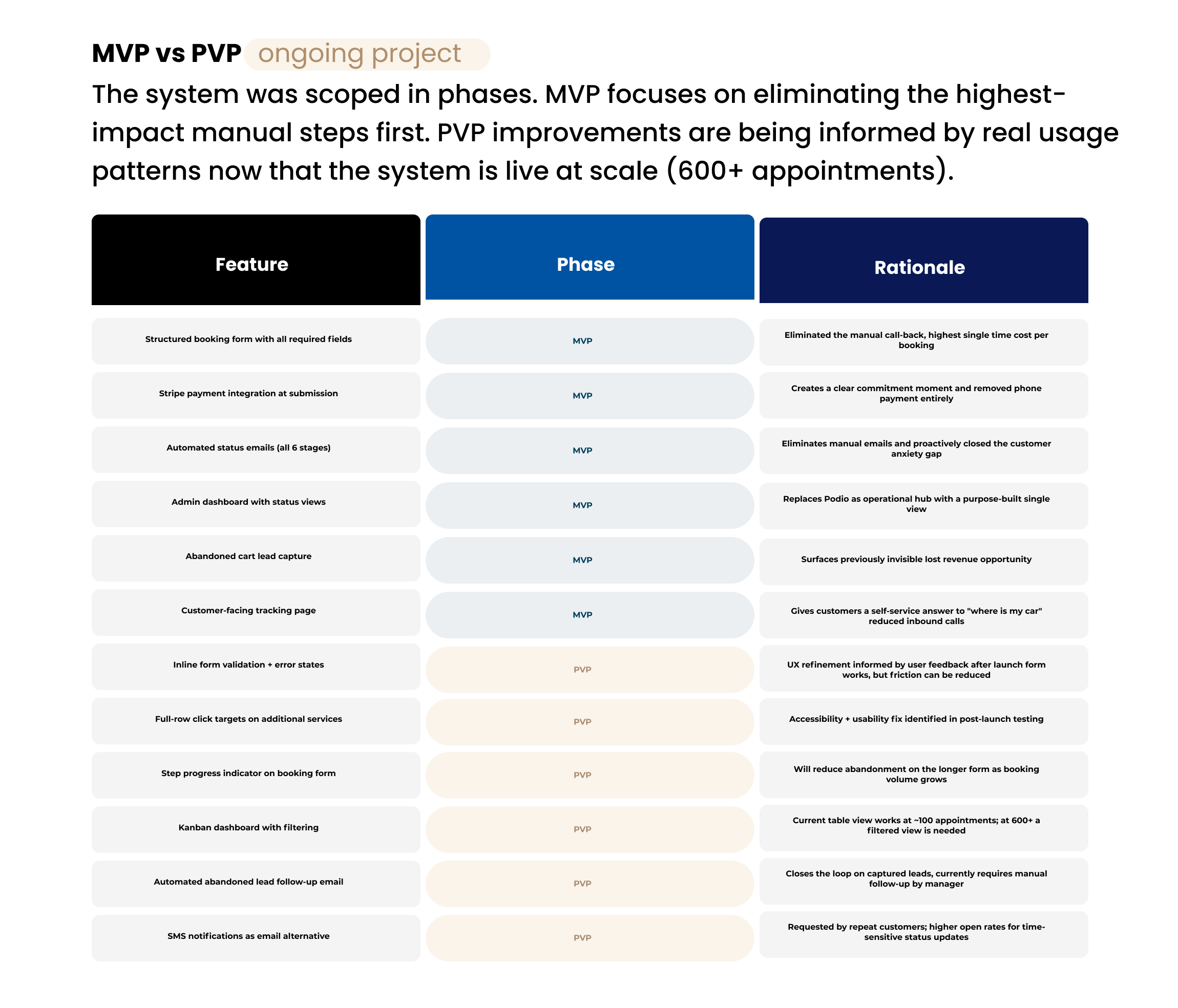
Please note that this project was scoped and built in phases. The MVP focused on the highest-impact operational problems first eliminating the manual booking call, integrating payment, and automating status emails because those were the steps costing Crystal Clean the most time and causing the most customer anxiety. Features like advanced dashboard filtering, Kanban-style appointment views, form progress bar and additional form UX refinements are actively in progress as PVP (post-viable product) improvements, informed by real user testing and usage patterns now that the system is live at scale. This is an ongoing project and the notes throughout this case study reflect where the system is today and where it's headed.

THE LESSONS LEARNED

  • Operational systems need to be designed around the humans running them, not just the customers using them, the admin experience matters as much as the booking flow

  • Automating communication proactively eliminates a whole category of inbound support volume

  • Building with no-code tools (Bubble.io, Stripe) allowed full-stack implementation as a solo designer